
Maltese History · c. 6500–700 BC
Prehistoric Malta
From Mesolithic hunter-gatherer seafarers to farming communities, monumental prehistoric complexes, collective burial traditions, and Bronze Age settlements, the prehistory of the Maltese Islands is a long and continually changing story of island life in the central Mediterranean.
Overview
A much longer story than the famous monuments.
Maltese prehistory extends across nearly six millennia of documented human activity. Recent excavations have fundamentally changed the islands' human history: people were reaching and occupying Malta before farming, centuries earlier than was long believed.
Excavations at Latnija in northern Malta have produced secure evidence for Mesolithic hunter-gatherers from about 8.5 to 7.5 thousand years ago. These communities crossed roughly 100 kilometres of open sea from Sicily, used hearths, made stone tools, hunted wild animals, and exploited marine foods. The discovery overturned the older model in which Malta's human story began only with Neolithic farmers.
Farming communities were established by c. 5500 BC. Over the following millennia, people transformed the landscape, developed distinctive ceramic traditions, buried their dead collectively, built large stone complexes, produced human and animal representations, and maintained connections with neighbouring parts of the Mediterranean.
These developments did not form one unchanging culture. Archaeological phase names such as Għar Dalam, Skorba, Żebbuġ, Mġarr, Ġgantija, Saflieni, Tarxien, Tarxien Cemetery, Borġ in-Nadur, and Baħrija are tools used to organise changing material traditions. Increasingly, radiocarbon dating, archaeometry, environmental archaeology, biomolecular analysis, and renewed excavation are refining—and sometimes challenging—older narratives based mainly on ceramic style.
01
Before Farming · c. 6500–5500 BC
Mesolithic seafarers reached Malta first
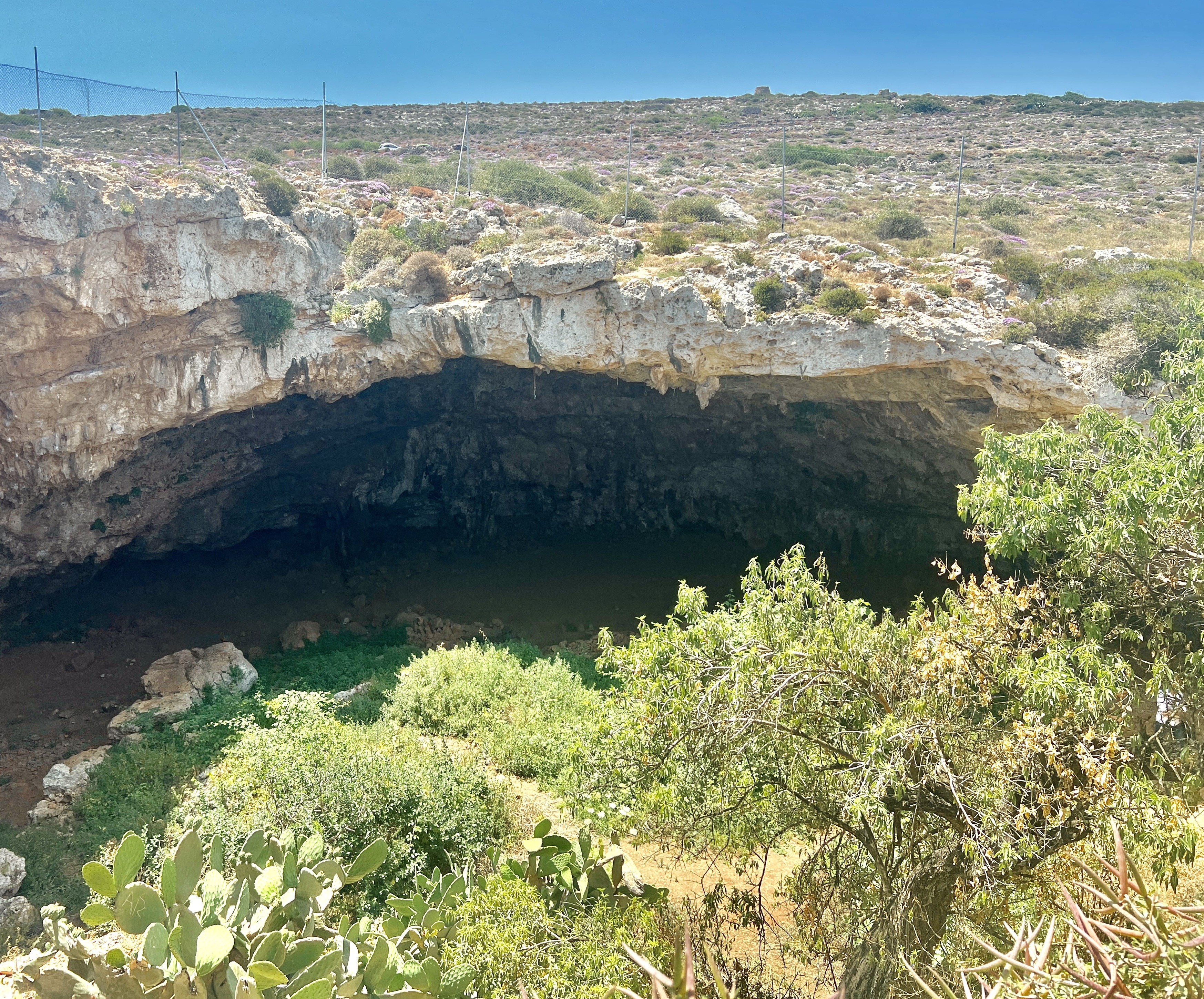
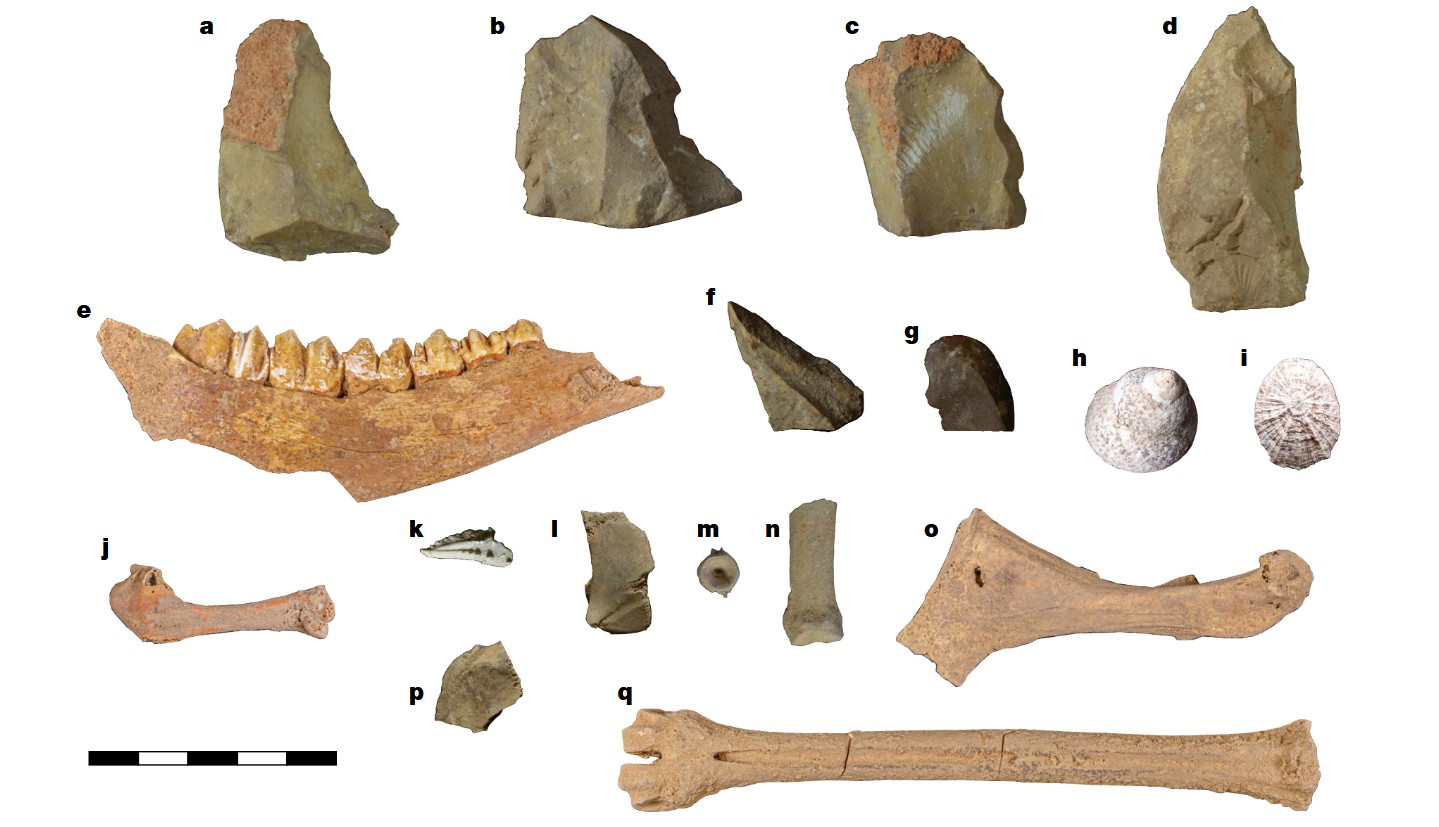
Until very recently, the conventional account of Maltese prehistory began with Neolithic farmers. Excavations at Latnija, a doline near Mellieħa in northern Malta, have changed that picture. Work carried out between 2021 and 2023 identified a well-stratified Mesolithic horizon with hearths, ash-rich deposits, stone tools, animal remains, marine shells, fish, and other evidence of human occupation.
Radiocarbon dating and Bayesian modelling indicate that occupation began by around 8.5 thousand years ago and continued until around 7.5 thousand years ago—approximately the period c. 6500–5500 BC. At that time, Malta was already separated from Sicily by a substantial sea crossing. Reaching the archipelago therefore required deliberate or repeated maritime journeys of around 100 kilometres, at least.
The people using Latnija exploited a wide range of wild resources. Red deer, birds, marine gastropods, fish, crustaceans, sea urchins, tortoises, and even seals are represented. This substantial use of marine resources contrasts with the predominantly terrestrial diets documented for many later Neolithic communities in Malta.
A 2026 demographic modelling study adds another important dimension. It concluded that Malta's small post-glacial landmass was unlikely to have supported an isolated forager population over the full millennium represented at Latnija. Continued contact through repeated long-distance voyaging is therefore a plausible requirement, placing Malta within a potentially wider network of Mesolithic mobility in the south-central Mediterranean.
02
The Neolithic
Farming transformed island life
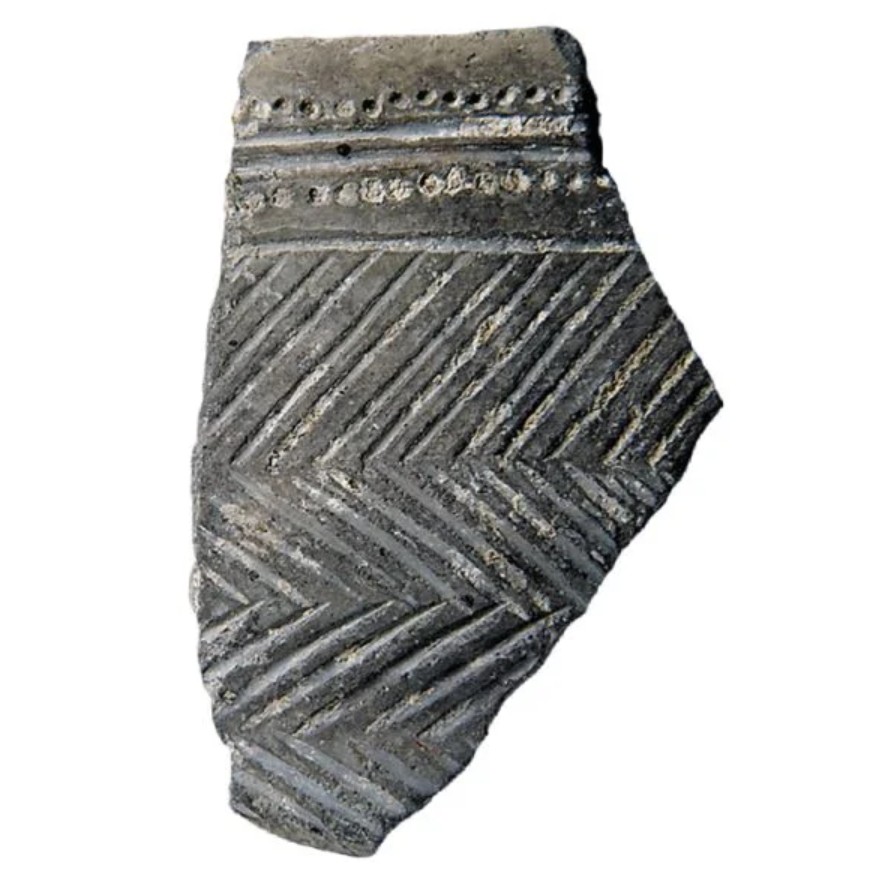
By approximately c. 5500 BC, Neolithic communities were established in Malta. The earliest securely dated Neolithic evidence is around 7.4 thousand years ago. Ceramics of the Għar Dalam tradition belong within the broader impressed-ware world of Sicily and southern Italy, while later Skorba material records continuing development within the archipelago.
These communities practised agricultural and pastoral lifestyles based on cultivated plants and domesticated animals. Cereals, sheep and goats, cattle, and pigs form part of the archaeological picture, although their importance varied through time and between sites. Settlement also required intensive knowledge of soils, water, seasonal conditions, and the limited resources of a small island environment.
The relationship between the newly documented Mesolithic occupants and the first farming communities is not yet fully resolved. What can now be said securely is that Neolithic settlers did not arrive in an untouched landscape: people had already been visiting and using Malta for centuries.
Connections beyond Malta continued. Imported raw materials, including obsidian, demonstrate participation in maritime exchange networks, while ceramic similarities link early Maltese communities to neighbouring regions.
03
How Archaeologists Organise the Past
A chronology that continues to change
Maltese prehistoric chronology has traditionally been organised into named phases derived largely from characteristic ceramic assemblages and the sites where they were first recognised. These labels are useful, but they are archaeological classifications—not the names of ancient peoples, ethnic groups, or political communities.
The FRAGSUS project substantially refined the sequence through AMS radiocarbon dating and Bayesian modelling, reducing reliance on ceramic style alone. The discovery of Mesolithic occupation at Latnija has since extended the known human story still further backwards. The ranges below are therefore best read as an orientation to current evidence, not as fixed boundaries.
| Archaeological period / phase | Approximate date | General character |
|---|---|---|
| Mesolithic · Latnija | c. 6500–5500 BC | Hunter-gatherer occupation, long-distance seafaring, wild and marine-resource exploitation |
| Early Neolithic · Għar Dalam / early impressed ceramics | from c. 5500 BC | Established farming communities; impressed ceramic traditions linked to the central Mediterranean |
| Skorba | c. 5400–4800 BC | Developing settlement and ceramic traditions |
| Fifth-millennium hiatus / sparse evidence | c. 4800–3800 BC | A major gap or reduction in the currently documented archaeological sequence |
| Żebbuġ | c. 3800–3630 BC | Distinctive ceramics and increasingly visible collective burial traditions |
| Mġarr | c. 3630–3510 BC | Short transitional interval represented especially through ceramic evidence |
| Ġgantija | c. 3510–3080 BC | Expansion and development of large megalithic complexes |
| Saflieni | c. 3080–2840 BC | Overlapping ceramic and funerary traditions; status as a discrete phase remains debated |
| Tarxien | c. 2840–2350 BC | Continued modification of monumental complexes, varied ceramics, figurative representation, and collective burial |
| Tarxien Cemetery / early “Thermi”-related traditions | c. 2350–1600 BC | Major changes in ceramics, burial, and social practice following the Late Neolithic; precise internal chronology remains debated |
| Borġ in-Nadur | c. 1600–750 BC | Bronze Age settlements, defensive architecture, storage, and extensive landscape occupation |
| Baħrija | c. 900–700 BC | Final Bronze Age / early Iron Age material tradition with wider Mediterranean connections |
A ceramic style can be common in one part of the archipelago and rare in another, and several styles overlap chronologically. New scientific dates can also shift or compress the boundaries once assigned through typology. The sequence is therefore a working archaeological model rather than a succession of neatly bounded “cultures.”
04
Late Neolithic Monumentality
The prehistoric complexes
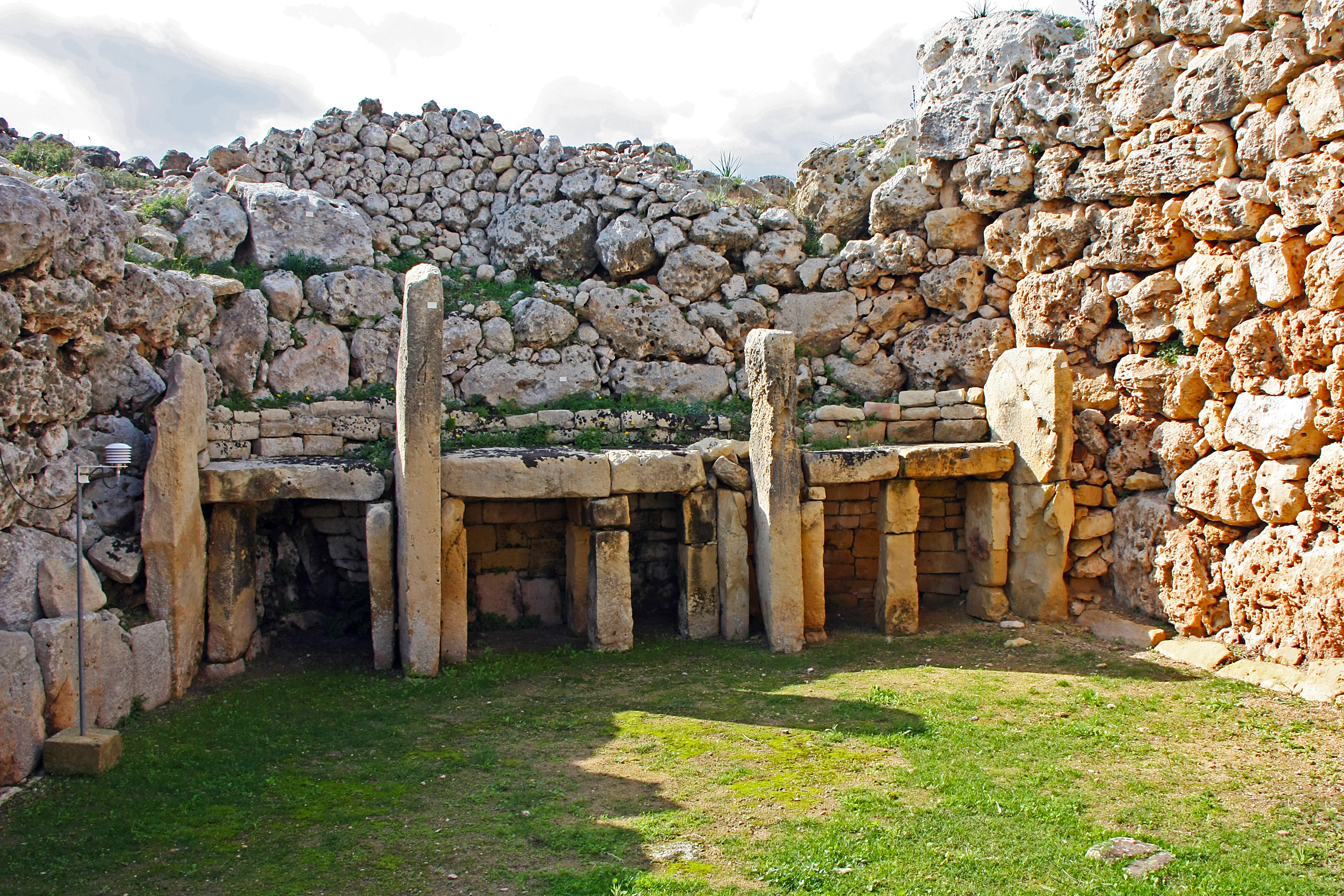
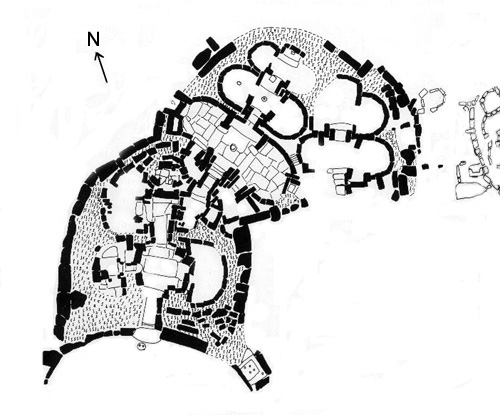
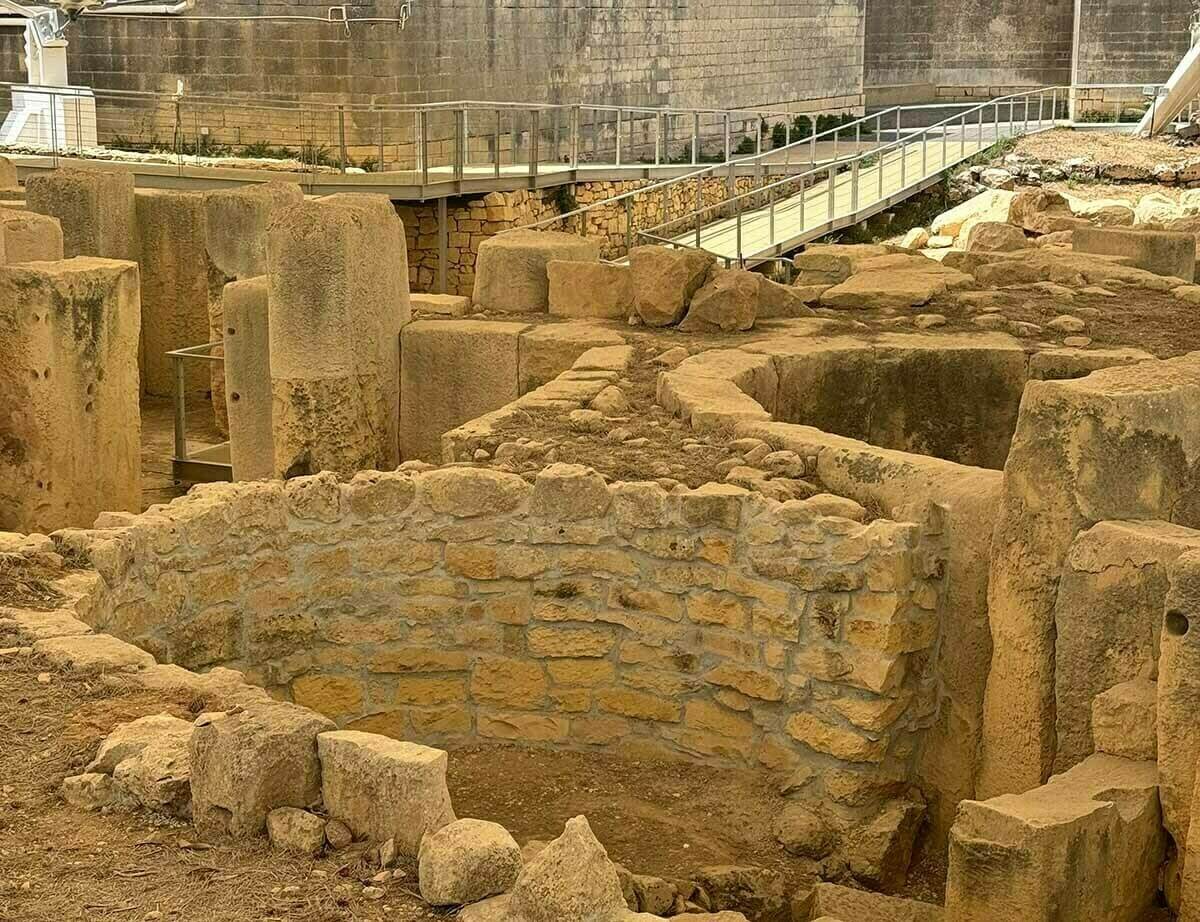
Ġgantija, Ħaġar Qim, Mnajdra, Tarxien, Skorba, Ta’ Ħaġrat, Kordin, Santa Verna, and related sites preserve some of the most remarkable monumental architecture of European prehistory. Tas-Silġ also preserves prehistoric remains within a site that would continue to be used and transformed in several later periods. Their construction required skilled stone-working, planning, repeated labour, and sustained investment by communities over many generations.
The Maltese-Canadian Museum uses the terms prehistoric complex, megalithic complex, or monumental complex rather than “temple.” The traditional label assumes a primarily religious function that the archaeological record cannot securely demonstrate. The fact that these structures were not ordinary houses does not, by itself, tell us exactly what happened within them.
Nor were these complexes static. Walls, apsidal spaces, entrances, thresholds, screens, floors, furnishings, and decorated architectural elements were constructed, altered, blocked, reopened, and rearranged. Their biographies matter: people repeatedly returned to the same places and changed them, creating new experiences of movement, visibility, and access.
Animal remains, ceramics, carved stone, figurative objects, and carefully organised interior spaces indicate that structured communal or ceremonial activities took place at least in some contexts. Their precise functions, however, remain open to interpretation and need not have been identical from site to site or century to century.
The word is deeply embedded in older scholarship and remains in the titles of many publications and official site names. It is retained in bibliographic titles where necessary, but not used here as a statement of ancient function. Neutral terminology allows architecture and material evidence to lead the interpretation rather than beginning with an assumed religious identity.
05
Death, Community, & Memory
The dead remained part of social life
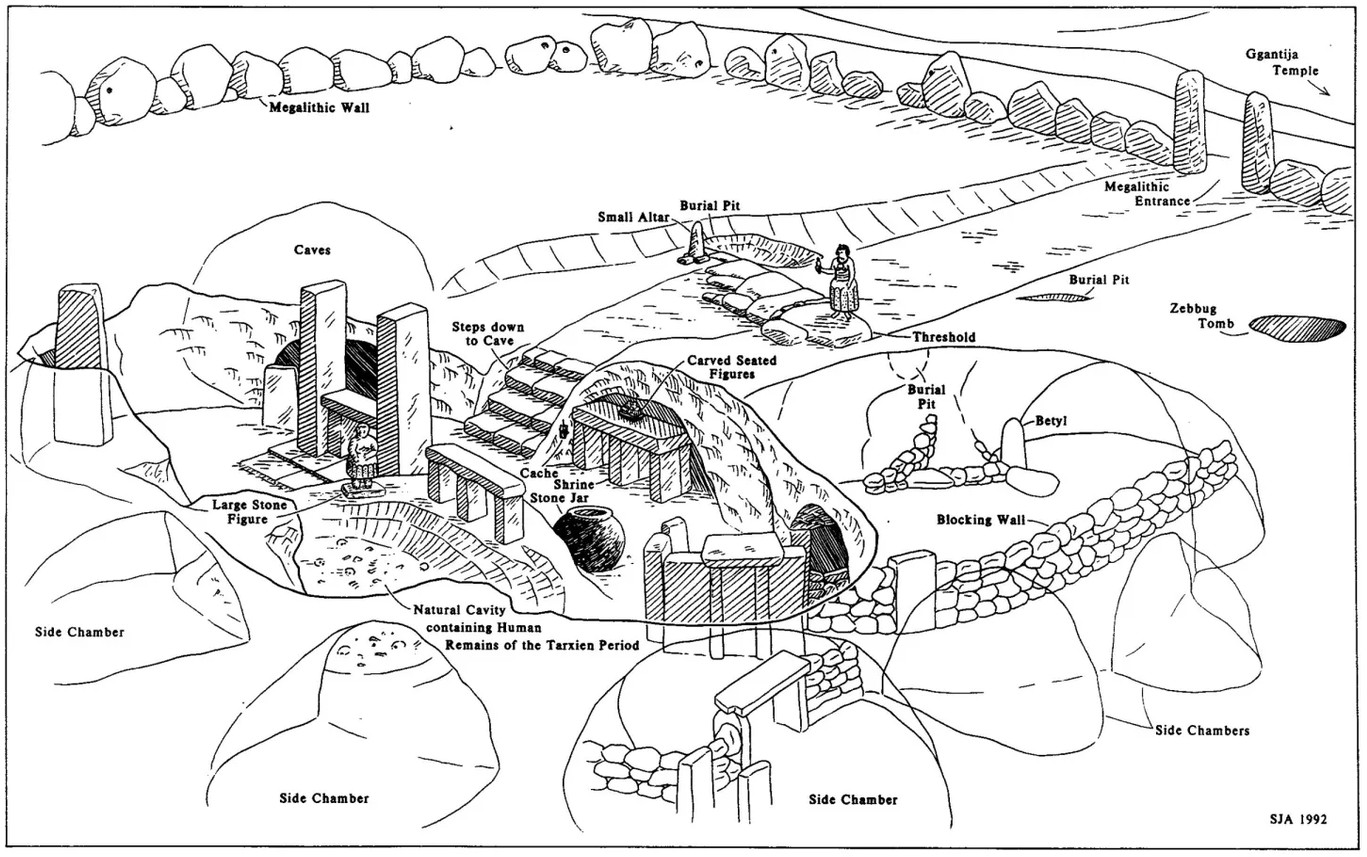
Collective burial is one of the defining sources of evidence for later Neolithic Malta. Rock-cut tombs and large subterranean complexes such as Ħal Saflieni and the Xagħra Circle contain the remains of many individuals, together with ceramics, pigments, ornaments, figurative objects, animal remains, and constructed settings.
The dead were not always placed once and left undisturbed. Evidence for disarticulation, reorganisation, repeated deposition, and the reuse of burial spaces shows that human remains could be revisited over extended periods. Such practices created long-term relationships between living communities, ancestors, places, and material objects.
Bayesian chronological work at the Xagħra Circle has sharpened this picture. Securely dated funerary activity is documented within roughly 3500–3000 BC, with larger-scale collective burial established by around 3000 BC. Use and monumentalisation of the underground complex continued intermittently to c. 2400 BC, before later Tarxien Cemetery activity.
These contexts are often described using religious language, but the beliefs attached to burial cannot be reconstructed directly. Archaeology can demonstrate repeated practices, spatial organisation, treatment of bodies, and associations between objects; explanations of cosmology or theology remain interpretations rather than known facts.
06
Bodies Without Names
Anthropomorphic representation
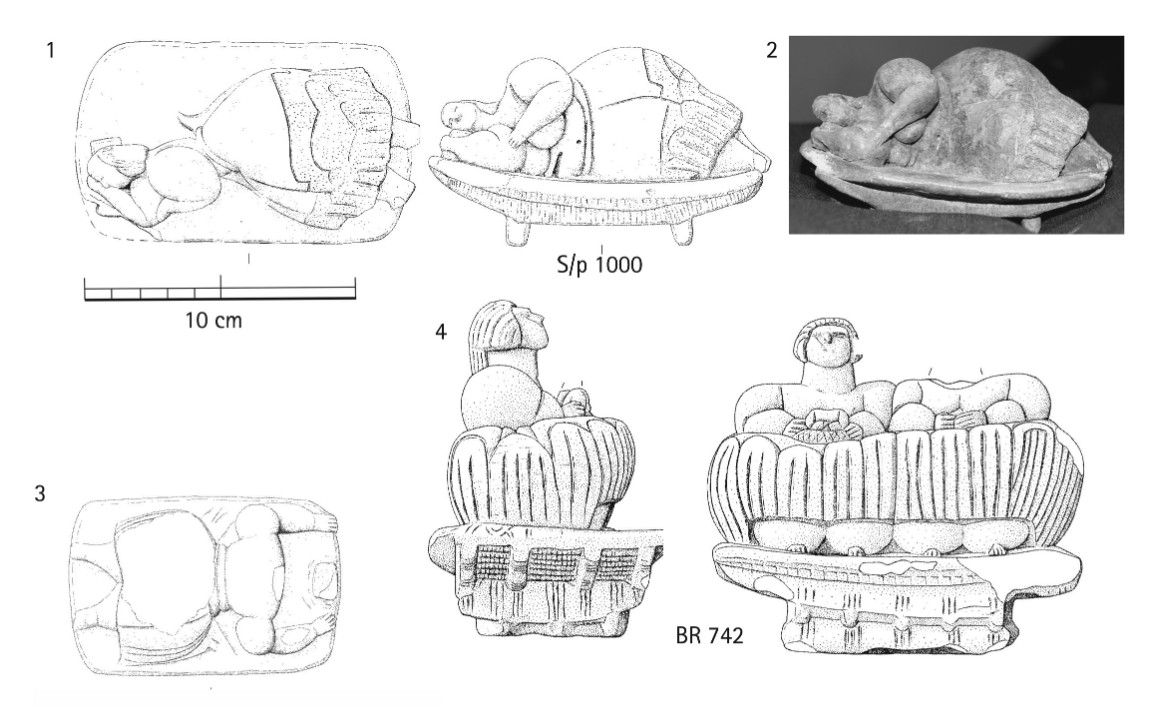
Prehistoric Maltese communities created anthropomorphic representations in stone and fired clay at scales ranging from miniature objects to large statuary. Some bodies are highly abstract, some are more naturalistic, some are clothed or ornamented, and others emphasise body mass. Heads could in some cases be detachable or interchangeable.
These objects have often been burdened with modern identities. Terms such as “Venus,” “goddess,” “fat lady,” and even the familiar nickname “Sleeping Lady” imply sex, gender, divinity, or social meaning that the objects themselves do not securely establish. Some prehistoric bodies appear deliberately sexless or anatomically ambiguous.
For that reason, the Maltese-Canadian Museum uses neutral descriptions such as anthropomorphic figure, anthropomorphic representation, or prehistoric statue. Conventional nicknames may be given where they help visitors recognise a well-known object, but they should be understood as modern labels rather than identifications of the person, sex, gender, status, or supernatural role represented.
Context is more informative than nickname. Whether a representation was deposited in a burial place, recovered from a monumental complex, broken deliberately, repeatedly handled, fitted with a removable head, or found with other objects can tell us far more about its archaeological life than an assumed identity such as “mother goddess.”
07
Objects as Evidence
Ceramics, stone, foodways, and exchange
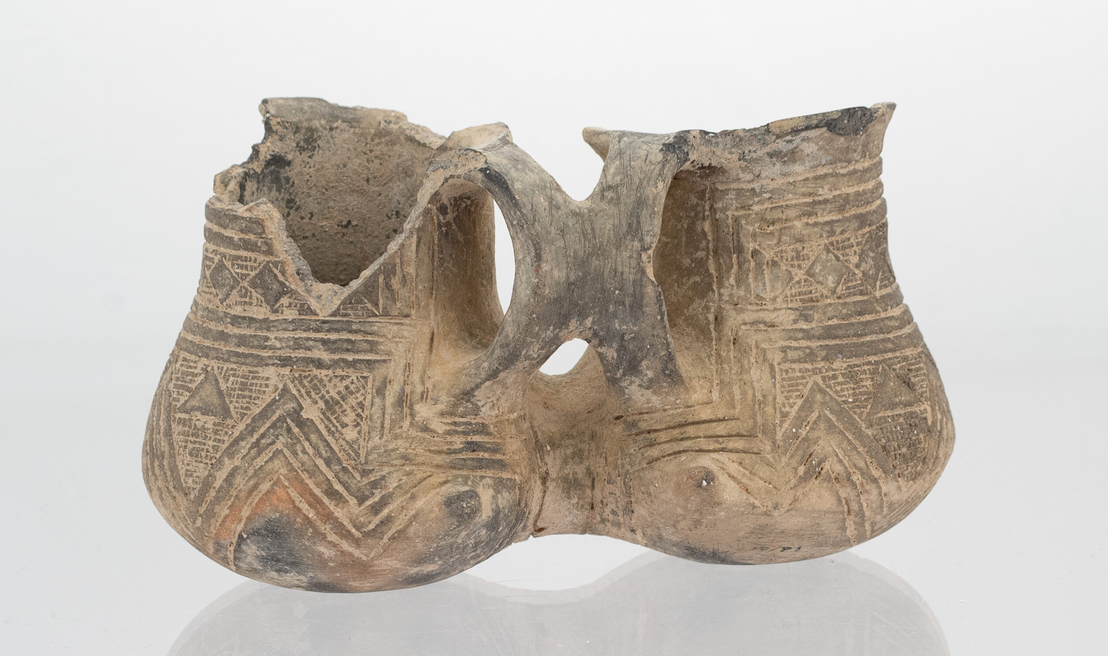
Ceramics are among the most abundant and chronologically useful materials in Maltese prehistory, but they are more than dating tools. Vessel form, fabric, firing, surface treatment, decoration, scale, repair, use-wear, residues, and archaeological context can all provide evidence for how people prepared, stored, served, shared, and deposited food and drink.
Recent work has also complicated the older phase sequence. Systematic FRAGSUS analysis retained and assessed very large ceramic assemblages, including material from domestic contexts rather than only monumental and funerary sites. This has shown that some ceramic styles have regional distributions and that style, chronology, and social practice do not always map neatly onto one another.
Stone technologies reveal both local adaptation and wider connectivity. The Mesolithic occupants of Latnija relied largely on locally available limestone for expedient flake tools. Neolithic communities used local and imported cherts as well as small quantities of imported obsidian, demonstrating access to maritime networks extending beyond the islands.
Scientific analysis increasingly allows objects to preserve traces of activities invisible to the eye. Paleoproteomic study of Late Bronze Age and Baħrija-period ceramics from Qlejgħa tal-Baħrija identified wheat- or cereal-derived proteins in several large storage vessels and milk-derived proteins in some tablewares and strainer vessels. The sample is limited and contamination is a major analytical concern, but the results show how biomolecular methods can contribute to the reconstruction of prehistoric foodways.
08
After the Late Neolithic
Bronze Age transformation, not disappearance
Around c. 2500 BC, the practices associated with the great Late Neolithic monumental complexes changed substantially. Large-scale construction and maintenance of those complexes ceased, while ceramics, burial customs, settlement organisation, and material culture took new forms. This transition should not be reduced to a mysterious “disappearance” of an imagined people.
Tarxien Cemetery and related early Bronze Age material mark part of this transformation. Later, Borġ in-Nadur communities occupied settlements with substantial architecture and, at the type site, a prominent defensive wall. Domestic structures, storage features, ceramics, stone artefacts, faunal remains, and other evidence reveal active settlement rather than a cultural vacuum after the monumental complexes.
The period c. 2000–1000 BC also shows broad occupation of the Maltese landscape and continuing contact with neighbouring regions. Borġ in-Nadur ceramics occur beyond Malta, while the archipelago's central position linked its communities to changing networks involving Sicily and the wider Mediterranean.
At In-Nuffara and Qlejgħa tal-Baħrija, storage facilities and settlement evidence provide different windows onto later Bronze Age life. Baħrija material dating to c. 900–700 BC belongs to the final part of this prehistoric sequence and overlaps with the emergence of the historical Mediterranean world encountered on the next page of this timeline.
Interpreting the Evidence
What we know—and what remains open.
Maltese prehistory is reconstructed from material evidence, not from the voices of the people who lived it. We do not know what prehistoric communities called themselves, how they named their monumental complexes, what languages they spoke in every period, or the identities represented by their statues.
What archaeology can establish is when people were present, what they ate, how they built, how they treated their dead, how ceramics and tools were made, where raw materials came from, how sites changed, and how communities remained connected across the sea.
The major breakthroughs of 2025 and 2026 demonstrate why this distinction matters. A story that once began with farmers now begins with Mesolithic seafarers. Future excavation and scientific analysis will almost certainly change parts of the story again.
Bibliography
Research used for this page
“Life on the Edge: Mesolithic Population Size and Viability on Malta.” PNAS Nexus 5 (2026): pgag234. DOI.
“Island Questions: The Chronology of the Brochtorff Circle at Xagħra, Gozo, and Its Significance for the Neolithic Sequence on Malta.” Archaeological and Anthropological Sciences 11 (2019): 4251–4306. DOI.
Temple Places: Excavating Cultural Sustainability in Prehistoric Malta. Volume 2 of Fragility and Sustainability – Studies on Early Malta. Cambridge: McDonald Institute for Archaeological Research, 2020.
“Figurines of Malta.” In The Oxford Handbook of Prehistoric Figurines, edited by Timothy Insoll, 729–754. Oxford: Oxford University Press, 2017. DOI.
“A Review of Malta’s Pre-Temple Neolithic Pottery Wares.” Open Archaeology 9, no. 1 (2023): 20220310. DOI.
“Hunter-Gatherer Sea Voyages Extended to Remotest Mediterranean Islands.” Nature 641 (2025): 137–143. DOI.
“Paleoproteomic Profiling of Organic Residues on Prehistoric Pottery from Malta.” Amino Acids 53 (2021): 295–312. DOI.
The Late Prehistory of Malta: Essays on Borġ in-Nadur and Other Sites. 1st ed. Archaeopress Publishing Ltd, 2015.
“Tradition, Time and Narrative: Rethinking the Late Neolithic of the Maltese Islands.” Malta Archaeological Review 11 (2012–2013): 16–24.
Ta’ Ħaġrat and Skorba: Ancient Monuments in a Modern World. Heritage Malta, 2008.