
Museum History
From a Parish Collection to a Community Museum
The Maltese-Canadian Museum has its origins in a small collection of religious objects associated with St. Paul the Apostle Church in Toronto. The parish has long served as an important spiritual, cultural, and social centre for Maltese Canadians, particularly for the community that developed in and around Toronto’s Junction neighbourhood during the twentieth century.
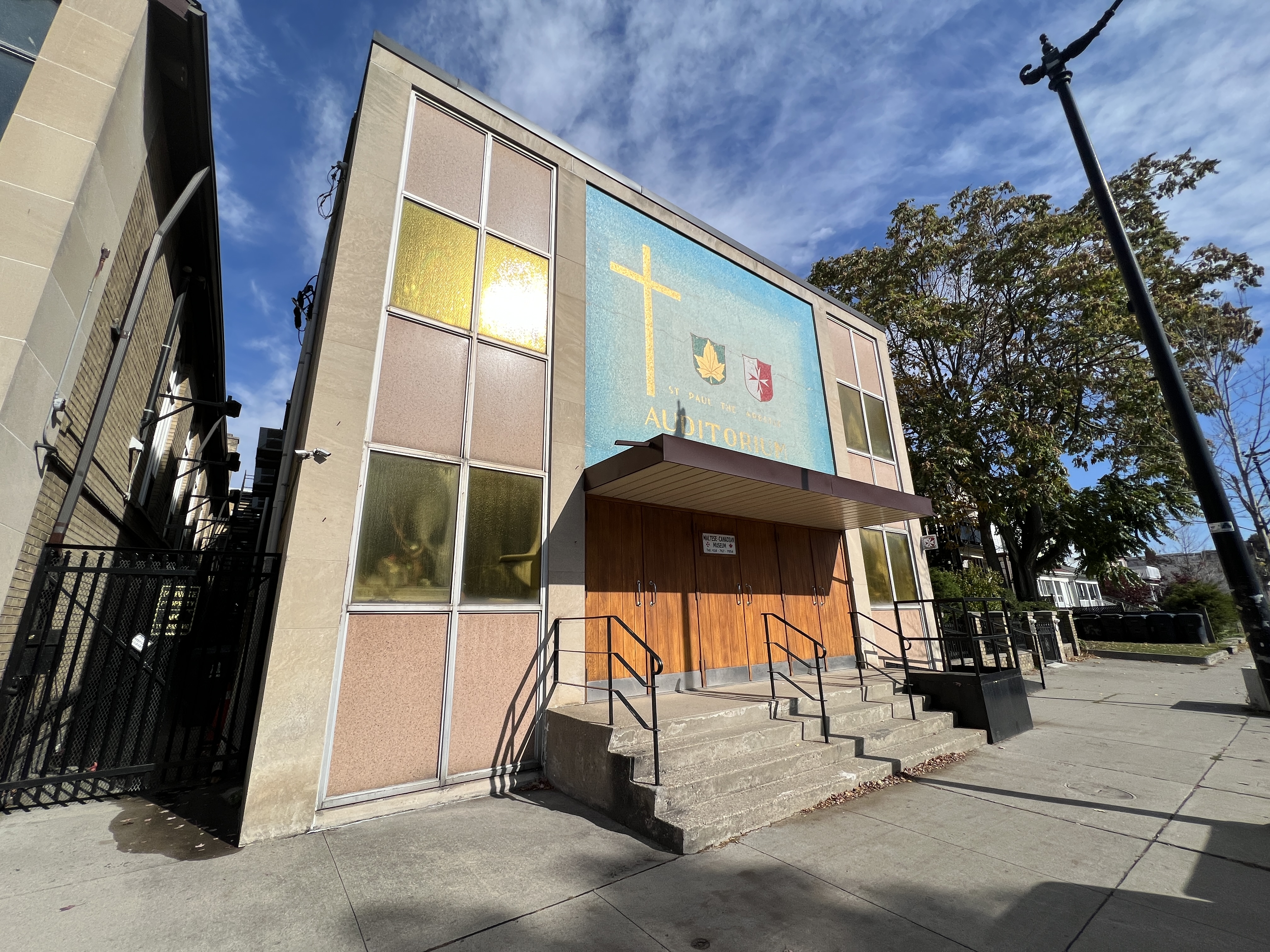
The first St. Paul the Apostle Church was constructed in 1930–1931. As the local Maltese population grew, it was replaced by a substantially larger church, begun in 1955 and completed in 1956. Additional parish facilities were completed in 1960. Together, these buildings formed a community complex in which religious life, cultural activity, and the preservation of Maltese heritage became closely connected.
The Development of the Collection
The museum began to take shape in its present form through the work of the Franciscan friar Father Raymond Falzon, O.F.M. During the 1980s, Father Falzon expanded the original church collection by gathering historic photographs, documents, and memorabilia relating to Malta and Maltese migration to Canada. He also developed displays presenting the history and culture of Malta and Gozo.
The Museum’s role became increasingly important during the late 1980s and 1990s, when a number of Maltese-Canadian associations and clubs closed or became inactive. Objects, records, photographs, and other materials belonging to these organisations were transferred to the museum, allowing an important part of the community’s institutional history to be preserved rather than dispersed or lost.
As the Maltese population of the Junction gradually declined and many families moved elsewhere in the Greater Toronto Area and beyond, the Museum increasingly served as a permanent repository for the memories and material heritage of the neighbourhood’s former Maltese community.
Opening to the Public
For many years, the collection could be viewed only during special events held in the upper hall of the St. Paul the Apostle Church complex. In 2016, during the pastorate of Father Manuel Parnis, M.S.S.P., work began to make the Museum more accessible to the general public.
The Maltese-Canadian Museum officially opened to the public on 29 January 2017. Richard S. Cumbo was appointed as its first curator and assumed responsibility for the continuing care, organisation, interpretation, and development of the collection.
A further significant addition followed the closure of the Maltese-Canadian Society of Toronto in 2019. Founded in 1922, the Society had played an important role in the development of Toronto’s Maltese community and in the establishment of both St. Paul the Apostle churches. Its surviving documents, photographs, and organisational materials were transferred to the museum, strengthening the collection’s coverage of nearly a century of Maltese-Canadian community life.
Preserving Maltese-Canadian Heritage
Today, the Maltese-Canadian Museum preserves objects and records relating both to the history of the Maltese Islands and to the experiences of Maltese migrants and their descendants in Canada. Its holdings include community and organisational archives, photographs, religious objects, works of Maltese craft, ceramics, glass, commemorative objects, coins, books, models, and other historical materials.
The museum also maintains a library devoted to the history, culture, language, and heritage of Malta and the Maltese diaspora. Together, the museum, archive, and library document the institutions, traditions, individuals, and everyday experiences that shaped Maltese-Canadian life.
The Museum continues to develop through the work of its staff, volunteers, donors, and community partners. Its purpose is not only to safeguard the material remains of the past, but also to make Maltese-Canadian history accessible to present and future generations.